On 23 June 2026, at Power2Drive Europe in Munich, Peblar reveals its Dual: a two-socket charger built to run two cars off a single grid connection. It is a smart product for a real problem. It is also, on the spec that matters most, a compromise. The Volt Time Two Pro is the dual-socket charger that does not make that compromise, and you can order it today. If you want the full breakdown, our Two Pro vs Peblar Dual comparison lays every line out side by side.
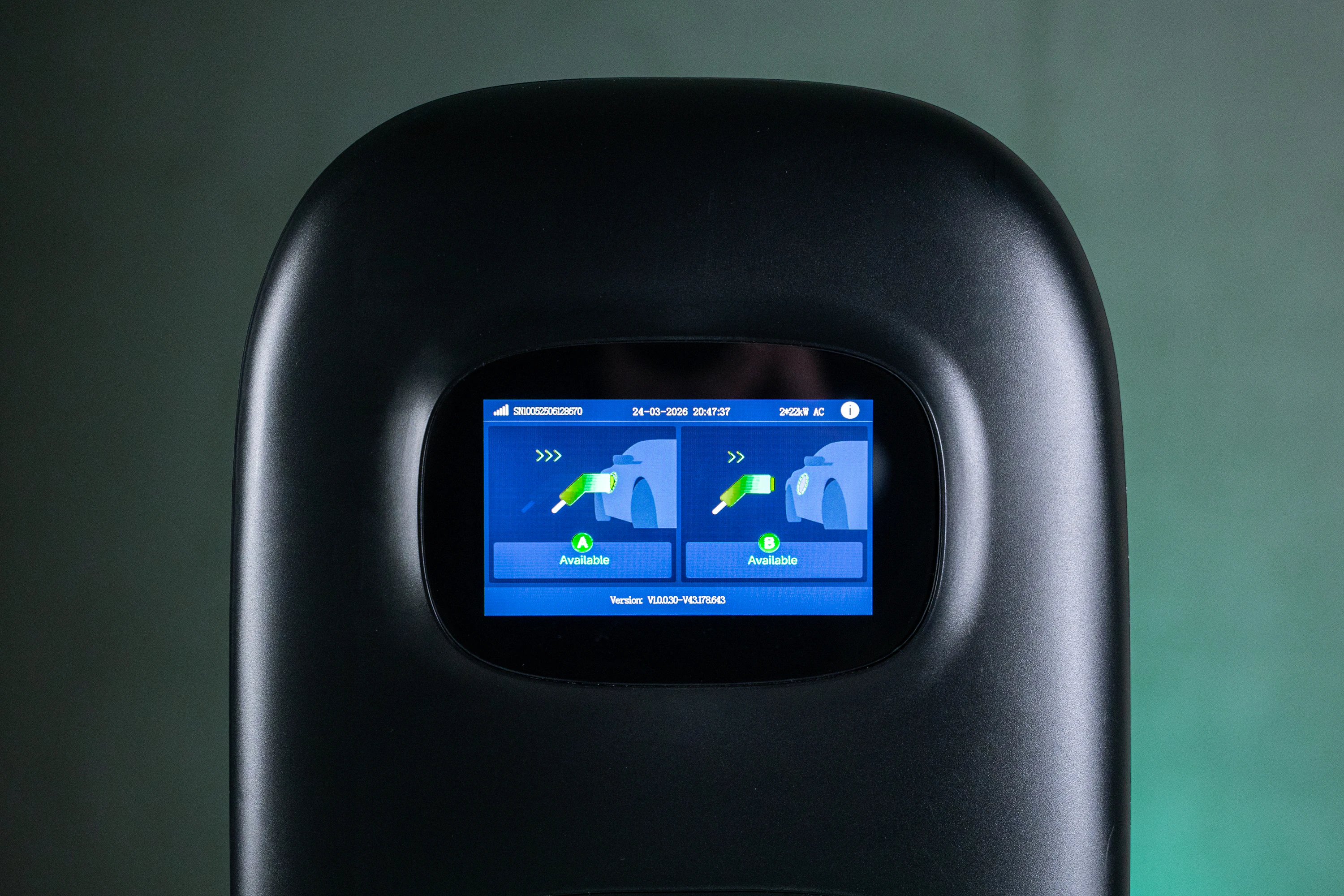
What the Peblar Dual actually is
Peblar has teased the Dual on its product pages as two sockets on one wallbox, sharing a single connection. The pitch is honest and the use case is real: plenty of parking sites physically cannot get a second grid connection, and for those locations a charger that splits one feed into two sockets is genuinely useful. We are not going to pretend otherwise. We even said so, in full, on our comparison page, where every Peblar figure is taken from a published Peblar source and anything they have not disclosed is marked as such rather than guessed.
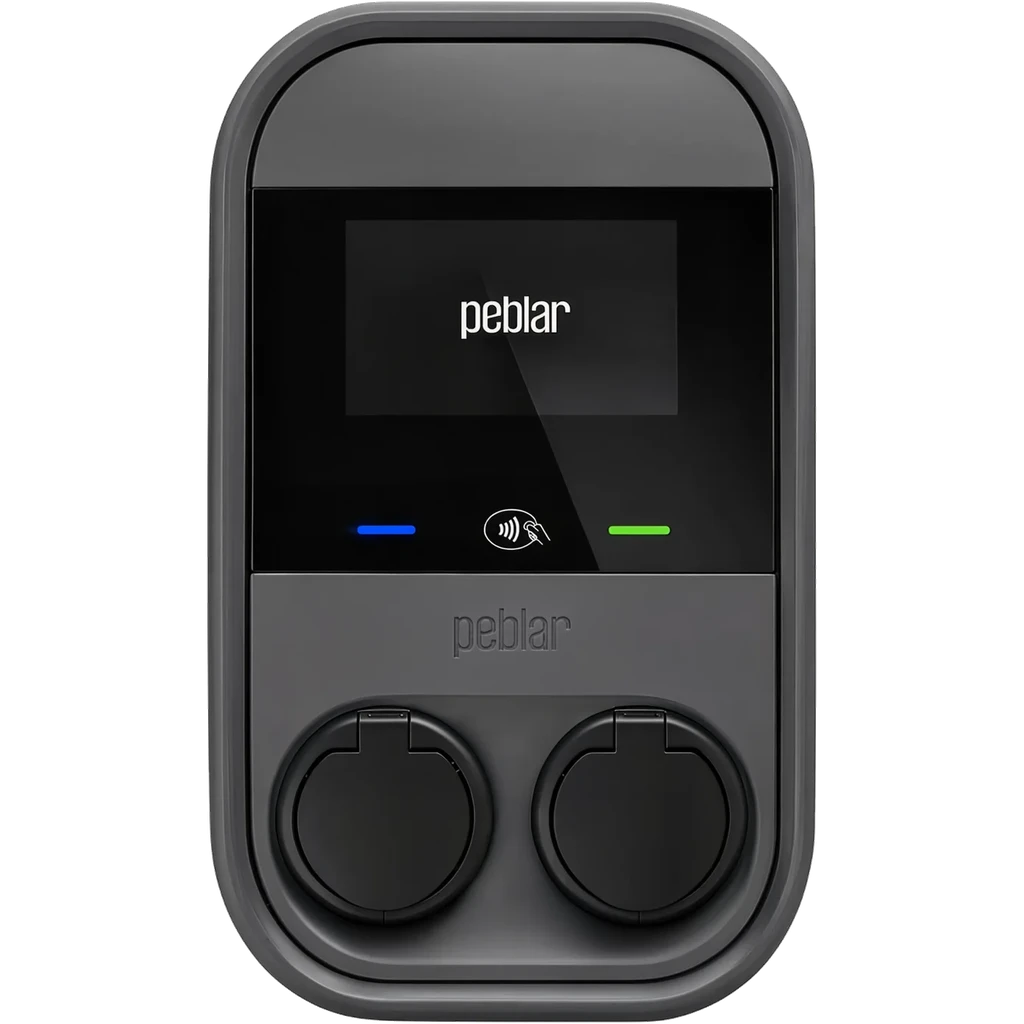
But "two sockets" and "two cars at full speed" are not the same sentence. That is the gap.
Shared power vs two real 22 kW sockets
Here is the difference in one line. The Peblar Dual takes a single connection of around 22 kW and splits it: one car at 22 kW, or two cars at roughly 11 kW each. The Volt Time Two Pro takes a 44 kW inlet and gives each of its two Type 2 sockets a full, independent 22 kW. Plug in two cars on a Two Pro and both charge at full speed at the same time. Plug in two cars on a Dual and they share.
For a home with one car that is irrelevant. For a commercial parking deployment, a fleet depot, or any site where two vehicles regularly charge at once, it is the whole game. Twice the sockets is not twice the throughput on a shared feed. On the Two Pro it is.
If your site genuinely cannot get more than a 22 kW connection, the Dual's shared model is the right tool and we will say so. If your site can get the power, splitting it in half is leaving charging speed on the table. The side-by-side comparison helps you work out which site you have.
Available today vs revealed in June
The other gap is simpler: the Two Pro ships now, across Europe, through Volt Time directly and through wholesale partners. The Peblar Dual has not launched. As of today its price, dimensions, ship date and even its ingress rating are unconfirmed, because the reveal is still days away. You cannot quote it, spec it, or install it yet. We covered the launch of the shipping product in our Two Pro launch announcement; the Dual's announcement is still in the future tense.
If you have a job on the books this quarter, "available today" is not a marketing line. It is the difference between closing the work and waiting.
What Peblar has not told you yet
A pre-launch product is allowed to keep some cards face down, and we are not going to invent specs for them. But it is worth being clear about what is still unknown about the Dual as of this article:
- Price and ship date are not published
- IP and IK ratings (water and impact resistance for outdoor use) are not stated
- Whether it has a built-in RCBO or RCD is not disclosed
- OCPP 2.0.1 and ISO 15118 / Plug and Charge support are unconfirmed
- Exact dimensions, weight and mounting are not public
By contrast the Two Pro is fully specified today: IP54 / IK10, two built-in 40 A Type C RCBOs with 6 mA DC residual current protection, a MID Class B meter on each socket for billing that an employer reimbursement scheme or tax authority will accept, up to 36 months warranty, and connectivity over 4G LTE, Wi-Fi and Ethernet with daisy-chaining for larger sites. None of that is "coming soon". It is on the datasheet.
Where the Peblar Dual is genuinely good
A comparison nobody trusts is a comparison nobody links to, so here is the fair part. Peblar's built-in payment is a real strength: their Dutch product page describes paying by contactless card or QR with no app and no account, which is a clean experience for public charging. Peblar is a solid Dutch manufacturer with good firmware. And the Dual's shared-feed design is the correct answer for power-constrained sites.
The Two Pro answers the payment point with a dynamic QR code and AFIR-aligned ad-hoc payment on its touch display, and partial contactless card support. If app-free card tap is your single hardest requirement, that is a point for Peblar, and we put it on the comparison page in those words.
The honest side by side
Read it spec by spec, Volt Time Two Pro first, Peblar Dual second:
- Power per socket: 2x 22 kW, independent | 1x 22 kW or 2x 11 kW, shared
- Grid feed: up to 44 kW | single ~22 kW
- Metering: MID Class B per socket | MID / Eichrecht
- Built-in protection: 2x Type C RCBO with 6 mA DC RCM | not disclosed
- Ingress / impact: IP54 / IK10 | not disclosed
- Platform: Plugchoice, included | OCPP 1.6J back office
- Availability: shipping now | reveal 23 June 2026
Every Peblar value here is sourced; see the bottom of the full comparison for the links. We will update both that page and this article the moment Peblar publishes confirmed specs.
If you are choosing right now
Both chargers run on real software. Every Two Pro ships pre-paired to Plugchoice, Volt Time's platform for smart charging, dynamic load balancing and OCPP management, with the installer and operator apps included. Fairly, Plugchoice also supports Peblar hardware, so a Dual can run on the same platform: the difference is that with Volt Time the hardware and the software come from one team.
So:
- Read the full Two Pro vs Peblar Dual comparison for the sourced, line-by-line spec face-off.
- See the Two Pro product page for the complete datasheet, or the original launch announcement.
- Become a Volt Time partner or request a quote if you install or sell at scale.
- For background on the platform behind it, Plugchoice has a pre-launch write-up on the Peblar Dual and a Peblar integration page too.
More launches and platform updates live in the Volt Time newsroom.
Sources
- Volt Time - Two Pro vs Peblar Dual comparison
- Volt Time - Two Pro product page
- Peblar - Dual teaser page
- Peblar - EN product table and NL product page
- Peblar - Power2Drive Europe 2026 event
- Plugchoice - smart charging and energy management platform
- European Union - Regulation (EU) 2023/1804 (AFIR)